The busy-ness of school and my other extracurriculars in the past few weeks have left me very little time to bird, unfortunately. However, one bird that is impossible to miss around my neighborhood is the enormous soaring turkey vulture. I decided to learn some more about these ever present birds during a study break.
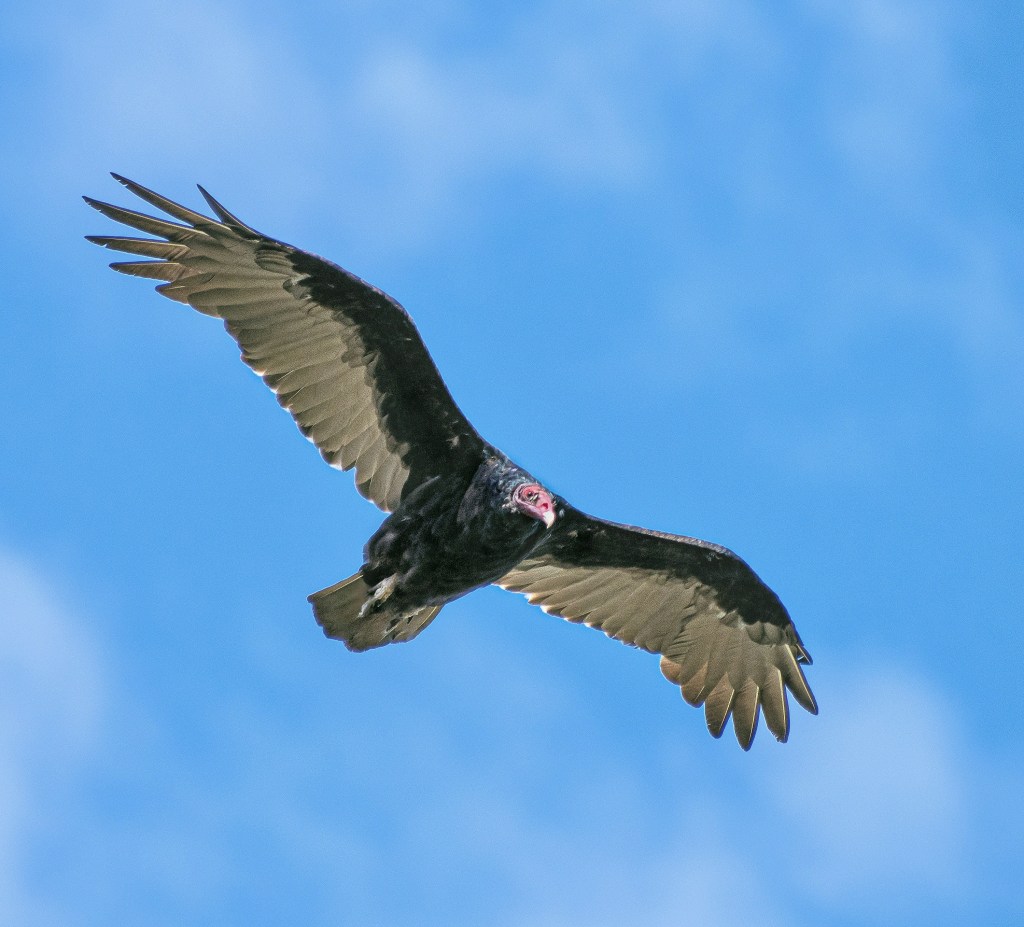
Turkey vultures are a category of raptor, and a sub-species of the New World vultures. They inhabit almost the entirety of the Americas, from southern Canada to the bottom of Argentina, living in a variety of areas. They are able to live in both open and moderately packed areas, in deserts and in forests. Turkey vultures are scavengers, cleaning up carcasses on the ground, using a strong sense of smell and sharp eyes to spot carrion but also flying low to detect the scent of decaying animals.
They have a moderately large wingspan of around 5.6 ft, weighing anywhere between 1.8-5.3 lbs. Typically, vultures living farther north are larger than southern vultures. Turkey vultures are some of the larger raptors, only outranked in size by eagles and condors. They boast long tails and finger-like structures at their wingtips.
One way to identify turkey vultures is through their “V” shape soar, with sparse wingbeats which leads to their famous wobbling flight. This method of flight allows them to stay in the sky using minimal energy. Along with their shaky soaring, they are renowned for their black bodies against their gray feathers and their bright red head (featherless, which is easier to keep clean after digging into carcasses!). They do not sing or call due to a lack of a voicebox, so their vocalizations are generally hisses and grunts.
Here are two more very interesting characteristics about turkey vultures:
- They urinate on their legs to stay cool. This process, known as urohydrosis, serves two functions. First, the evaporation of the urine leads to a cooling effect. Second, the urine helps to kill bacteria and toxins (e.g. anthrax and botulism) that the turkey vulture may have picked up while standing in and around their prey.
- They use vomiting as a defense mechanism. Turkey vultures can vomit their partially digested food when threatened to not only deter predators but also lighten their bodies to make it easier to escape.
Would you be brave enough to watch a turkey vulture in action up close?


 The Curious Birder
Leave a reply to The Curious Birder Cancel reply