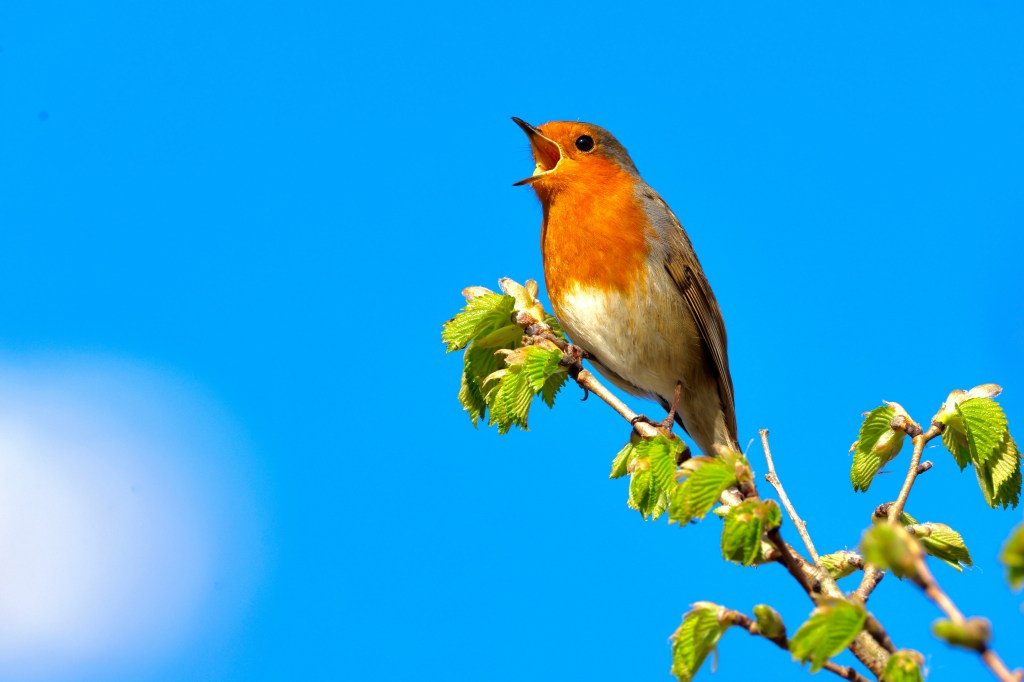
This past weekend, I went birding in my backyard, and the usual Blue Jays, Northern Cardinals, House Finches, and American Robins that I typically see and hear seemed to be eerily quiet for most of that hour. In fact, their silence was deafening. And this made me wonder- why do birds stop singing?
Turns out that birds pause their solos for a multitude of reasons. Singing is energy intensive, which forces the bird to either sing or call (to establish territory, attract a mate, and communicate) or instead conserve energy.
Time of the day
- Birds sing mostly in the morning because that is when they have the most energy. Midday is the hottest, so birds tend to not sing as it would exhaust them to continuously sing in the heat.
- In addition, singing in the mornings also apparently confers a reproductive advantage. Researchers from Duke University found that swamp sparrows warmed up their vocals by singing a lot in the early morning, and that their vocalizations became faster and more wide ranging as they sang throughout the day. This improvement in singing quality makes a male swamp sparrow more attractive to a female.
- A notable case is the mockingbird, which is known to sometimes sing all night long in an attempt to find a mate.
Change in Weather
- Birdsong travels far on calm still mornings. But when conditions become windy, cloudy, or rainy, birds will instead focus on conserving their energy. Birds have something called a paratympanic organ in their inner ear, which is theorized to contain hair cells that are very sensitive to changes in air pressure and infrasound (low frequency sound waves that are generated by storms and can travel very long distances). Birds can likely sense storms way before humans can, and these impending storms lead to behaviors prioritizing safety, such as foraging for food or finding shelter, instead of singing.
- Hot weather may also affect singing. One study found that male zebra finches sang significantly less and with shorter syllables at high temperatures.
Food / foraging
- When birds are focused on foraging, they choose to spend energy looking for food rather than spend that energy singing.
- If food is scarce, many birds will refrain from singing because it isn’t vital to their survival, so they don’t prioritize spending energy to sing.
When a predator is nearby
- Most animals, especially predators on the hunt, can tell where a sound is coming from. When birds sing, they make themselves (and their location) known, which makes them easy targets for predators. Birds can stop singing as a protective measure if they or any bird nearby spots a predator like a hawk, owl, or cat.
These are only a few reasons why birds might stop singing. So why do I think birds stopped singing during my birding hour this past weekend? My guess is that it was a combination of not so great weather (cold, rainy, windy) and maybe the Cooper’s Hawk that my brother saw a bit earlier.
Now that my school year is winding down, I am spending more time birding and plan to post much more frequently!


Leave a Reply